A Bergen County Homeowner’s Complete Guide to Choosing the Right Garage Floor — The First Time
Introduction: Your Garage Floor Takes More Punishment Than You Think
Most Bergen County homeowners focus on what goes in the garage — the cars, the tools, the weekend projects. The floor gets about five minutes of thought, usually right before someone pulls up a big-box store website and clicks “add to cart” on a $79 paint kit. That’s a mistake that costs real money to fix.
Think about what that slab actually endures. Road salt brine tracked in from Routes 17, 4, and 80 during every winter commute. Freeze-thaw temperature swings that can send concrete from 5°F to 50°F in a single afternoon in January. Hot tires from a car that’s been sitting in a Paramus parking lot all summer, rolling across a floor that isn’t built to handle 150°F+ contact heat. The garage floor in Bergen County doesn’t live in a mild, controlled environment — it lives in one of the most chemically and thermally abusive conditions of any surface in your home.
The choice you make this weekend can either last two years or twenty. This guide compares all three major residential garage flooring options head-to-head: professional epoxy coating, interlocking garage floor tiles, and garage floor paint (including DIY epoxy kits). We break down durability, real installed costs, installation requirements, maintenance load, appearance, and long-term value — with specific data for Bergen County conditions. For a deeper look at pricing alone, our complete garage flooring cost guide breaks down line-by-line costs for each system.
Quick Comparison: Garage Epoxy vs Garage Tiles vs Garage Paint
Here’s your 30-second snapshot. Every data point in this table is unpacked in detail in the sections below — because the numbers only make sense with context.
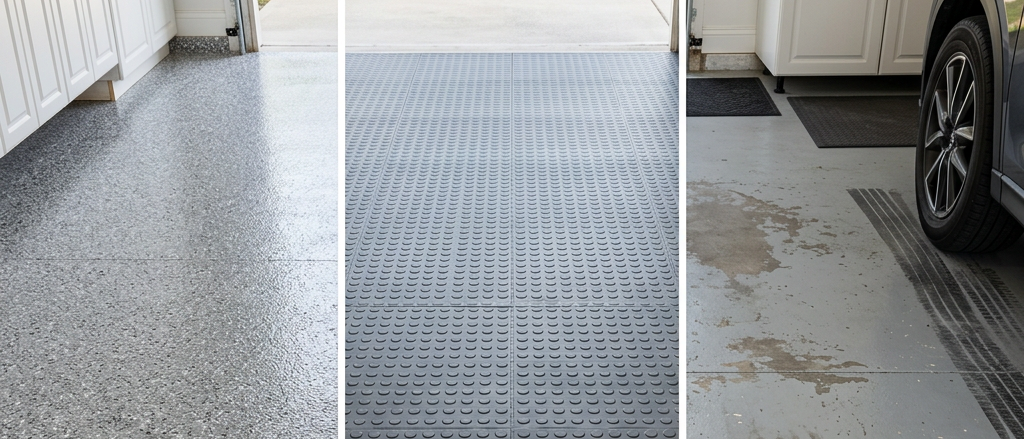
| Factor | Professional Epoxy | Interlocking Tiles | Garage Paint / DIY Kit |
|---|---|---|---|
| Durability / Lifespan | 10–20 years | 10–20+ years | 1–3 years |
| Upfront Cost (2-car garage) | $2,000–$4,300 (Bergen County avg) | $800–$2,000 | $150–$550 |
| DIY-Friendly | No (pro recommended) | Yes (easy) | Yes |
| Hot Tire Resistance | Excellent | Excellent | Poor (peels) |
| Salt & Moisture Resistance | Excellent | Fair (seams allow moisture) | Poor |
| Installation Time | 1–2 days | Half-day | 1 day + cure time |
| Maintenance | Very easy (sealed surface) | Easy (lift and clean) | Moderate (degrades over time) |
| Best For | Long-term homeowners | Renters, quick upgrades | Temporary / budget situations |
Professional Epoxy Coating: The Long-Game Investment
A professionally installed 100% solids epoxy system — diamond-ground, primed, body-coated, and sealed with a UV-stable polyaspartic topcoat — is the only garage floor option that simultaneously protects your concrete and transforms how it looks. The chemistry matters here. A professional system cures to 10+ mils of thickness, compared to the 3 mils you get from a DIY kit, and that thickness gap is the entire story of why one lasts 15 years and the other peels in August.
Durability That Actually Accounts for NJ Winters
A properly installed professional system delivers 10–20 years of service life in a residential Bergen County garage. The polyaspartic topcoat is the component that separates a premium installation from a standard one: it adds UV stability (preventing the amber yellowing that plagues cheap epoxy within three years), genuine hot-tire resistance, and a hard abrasion surface that handles daily vehicle traffic without degrading. Straight 100% solids epoxy without a polyaspartic topcoat performs well, but it is vulnerable to yellowing under UV exposure and should be reserved for garages that don’t receive significant direct sunlight.
NJ winters make slab protection a non-negotiable consideration. Road salt brine — the liquid deicer applied heavily on Routes 4, 17, and 80 from November through March — is one of the primary causes of concrete spalling in residential garages. The chloride ions penetrate untreated concrete, attack the rebar, and cause the surface to pop and flake from within. A sealed, properly bonded epoxy system stops salt from ever reaching the slab. Over a 10-year period, that protection alone justifies the cost difference over any alternative.
Real Cost in Bergen County
In Bergen County, a professionally installed 2-car garage floor runs $2,000–$4,300 fully installed. That price includes diamond grinding (the step that distinguishes a lasting job from a peeling one), crack and joint repair, 100% solids base coat, vinyl flake broadcast, and a UV-stable polyaspartic topcoat. Prices vary based on slab condition — significant crack repair or moisture mitigation primer adds cost — but the range above reflects the realistic Bergen County market for a quality installation on a typical 400–500 sq ft two-car garage.
Compare that to the DIY kits available at home improvement stores for $150–$550. Those kits typically use thin, water-based formulas that cure to roughly 3 mils — and they begin failing within the first summer when hot tires make contact. The math on a per-year basis is stark: a $2,700 professional floor that lasts 15 years costs $180 per year. A $400 DIY kit that lasts 2 years and requires stripping and re-coating costs more than $200 per year before labor is factored in. The professional option is the cheaper choice when measured correctly.
The Installation Process — Why Preparation Is Everything
A professional installation runs 1–2 days. Day one begins with diamond grinding — a walk-behind machine that opens the concrete’s pores, removes any surface contamination, and creates the mechanical profile the coating bonds to. No other surface preparation method achieves the same result; acid etching is insufficient for 100% solids systems and is not used by quality contractors. After grinding, crack and joint repair is completed with polyurea filler, the base coat is applied, and vinyl flake is broadcast across the wet surface. Day two, after the base coat has cured overnight, the polyaspartic topcoat goes down. The floor is walk-ready within hours of the topcoat and drive-ready within 24 hours — significantly faster than a standard epoxy-only system.
One critical pre-installation step that separates experienced contractors from inexperienced ones: moisture vapor emission testing. Bergen County has a significant proportion of garages built on slabs with elevated moisture vapor transmission — water vapor moving upward through the concrete from below. If a coating is applied over a high-MVE slab without a moisture-mitigating primer, it will delaminate from beneath, typically within 6–18 months. A contractor who doesn’t test first is a contractor to avoid. For more detail on system selection, see our guide to choosing the right epoxy system for your garage.
Maintenance: Almost Zero
A sealed epoxy floor is the lowest-maintenance garage floor surface that exists. Sweep weekly, mop monthly with a pH-neutral cleaner, and wipe up oil spills immediately — they don’t penetrate the sealed surface. The seamless nature of an epoxy coating means no grout lines, no gaps, and no places for road salt or oil to hide and work into the substrate. A properly installed professional epoxy floor in year 10 looks essentially the same as it did in year one, with no re-coating required.
Appearance: The Clear Winner
This is where professional epoxy wins decisively against every competitor. Solid color, vinyl flake broadcast, metallic swirl — the design options are wide, and quality contractors can show you physical samples in your garage before a drop of material is applied. Vinyl flake is the most popular finish in Bergen County: it hides minor surface imperfections, adds texture for slip resistance, and produces a showroom floor look that transforms how the entire garage feels. A Paramus homeowner who replaced stained, salt-pitted concrete with a metallic flake epoxy installation reported being able to wipe motor oil off the surface immediately with a paper towel — zero staining, zero absorption.
Honest Limitations
Professional epoxy is not the right choice for every situation. It cannot be applied over slabs with uncorrected, active moisture problems without a moisture-mitigating primer. It cannot go over existing paint or thin coatings without full removal first — and that removal adds $1–$3 per square foot to the project cost. Application temperatures below 50°F require heating the garage, which adds a logistical step in shoulder-season installations. And while polyaspartic topcoats cure quickly for foot traffic, a full cure for regular heavy vehicle use takes 24 hours — plan for one overnight garage vacancy.
Interlocking Garage Tiles: The Flexible, Renter-Friendly Option
Interlocking polypropylene garage tiles occupy a unique position in the garage flooring market: they’re the only option that requires zero surface preparation, delivers same-day usability, and can be taken with you when you move. For the right situation, they’re genuinely excellent. For the wrong one, they’re an expensive band-aid over a problem they don’t solve.
Durability: Better Than Most People Expect
High-quality polypropylene interlocking tiles last 10–20+ years under normal residential vehicle traffic. They resist hot-tire marks — polypropylene doesn’t soften and release adhesion under tire heat the way thin coatings do — and they don’t yellow under UV exposure. The critical durability advantage tiles have over coatings: individual tiles can be replaced if one cracks, stains heavily, or gets damaged by a point load. On an epoxy floor, a significant impact damage or stain requires professional spot repair. On a tile floor, you pop out one tile and snap in a replacement for a few dollars.
Porcelain tile is the premium outlier worth mentioning. Genuinely beautiful, 20+ years durable, and it elevates a garage to a level that polypropylene tiles simply cannot match visually. But porcelain costs as much as professional epoxy or more once installation is factored in — it requires mortar, grout, and a professional tile setter — and it will crack along any slab movement lines. In Bergen County, where freeze-thaw cycling stresses concrete slabs seasonally, porcelain over an uncontrolled substrate carries real risk.
Cost: The Easiest Math in This Comparison
Polypropylene tiles run $2–$5 per square foot in materials, putting a typical 400–500 sq ft two-car garage at $800–$2,500 in materials alone. No tools beyond a rubber mallet and a utility knife are required. For a motivated DIYer, the labor cost is zero. That makes the total cost for a quality tile installation substantially below both professional epoxy and professional coating alternatives — and the result is genuinely attractive and durable.
Installation: The Killer Advantage
No surface prep. No grinding. No etching. No cure time. Snap tiles together over existing concrete — even over stained, ugly, or oil-marked concrete — and you’re done in half a day for a two-car garage. Because the tiles are not bonded to the slab, they can be removed entirely and taken with you when you move. That portability makes interlocking tiles the clear first choice for renters, for homeowners who plan to sell within 12–24 months, or for anyone who wants to transform their garage floor this Saturday without renting equipment or scheduling contractors weeks out. The zero-downtime installation also means your vehicles go back in the same day — there is no cure window to manage.
Maintenance: Simple, With One Caveat
Day-to-day maintenance is straightforward: sweep, hose down, or pressure-wash as needed. Individual tiles that get heavily stained — by rust, oil, or chemical spills — can be popped out and replaced for a fraction of the cost of refinishing an epoxy floor. The main maintenance challenge is the seams. Dirt, debris, and especially road salt brine collect in the gaps between tiles. Periodic lifting and cleaning of the subsurface is required, particularly in high-salt-exposure garages — which in Bergen County means virtually every garage attached to a daily-driver vehicle.
The Critical Weakness: The Seams
The seams between tiles are the structural vulnerability of this entire category, and in Bergen County’s climate, they matter significantly. Water, road salt brine, and motor oil work through the gaps between tiles onto the unprotected concrete slab below. In a freeze-thaw climate like northern NJ, unprotected concrete that absorbs salt and moisture over years develops spalling, pitting, and surface cracking — the same damage tiles are often installed to cover. Tiles hide the existing problem but don’t fix it, and they create conditions for the problem to continue developing underneath.
Point loads are the second major limitation. Motorcycle kickstands, hydraulic jack stands, and heavy rolling tool chests can dent or shift polypropylene tiles, particularly lighter-gauge products. Solid PVC tiles at $3–$5 per square foot handle point loads better than perforated polypropylene, and are the better choice for any garage that doubles as a workshop. And while tiles look clean and organized, the visible grid pattern and seam lines give a distinctly workshop aesthetic rather than the seamless, high-end showroom finish of a quality epoxy floor.
Garage Floor Paint: The Budget Option With a Short Clock
Garage floor paint is the most purchased and most quickly regretted garage flooring option on the market. It’s not that it’s a bad product — it’s that it’s consistently sold and applied in contexts where it cannot succeed. Understanding what it actually is explains why.
What It Actually Is (And Isn’t)
Most “epoxy paint” sold at home improvement stores is not true epoxy. It’s a latex or water-based alkyd paint with a small percentage of epoxy resin added for marketing purposes. Genuine two-part DIY epoxy kits — where Part A and Part B are mixed before application — are a step up, but they still use thin, low-solids formulas. A quality two-part DIY kit cures to roughly 3 mils of dry film thickness. A professional 100% solids system cures to 10+ mils. That gap in thickness is why one withstands a hot tire and one doesn’t: thinner coatings simply don’t have the mechanical mass to resist the shear forces and heat from a 150°F+ tire rolling across them.
Durability: Set Realistic Expectations
The honest expected lifespan for a garage floor paint or DIY epoxy kit with regular vehicle traffic is 1–3 years. Hot tires are the primary failure mechanism. A car parked in an NJ summer reaches tire surface temperatures above 150°F; when it pulls into the garage, those tires act as heat guns applied directly to a thin coating. Peeling typically begins within the first summer, starting at the entry point where hot tires make first contact. Water-based two-part epoxy kits perform better than single-part latex paint but still fail within 2–5 years under vehicle traffic — and that upper end of the range requires diamond grinding prep that most DIYers skip, which knocks performance back to the 1–3 year range immediately.
Cost: The Number That Looks Good Once
Garage floor paint is the most budget-friendly option at face value: $150–$550 all-in for a two-car garage, including concrete etching solution, rollers, masking tape, and a quality two-part epoxy kit. That price is genuinely attractive. What it doesn’t include is the cost of stripping it before the next application — because any higher-grade coating applied over existing paint requires full removal of the old coating first, adding $1–$3 per square foot in prep costs to whatever comes next. Every budget garage paint job eventually creates a more expensive future re-coating project.
Installation: Accessible, With Strict Conditions
Roll-on application over acid-etched or lightly prepared concrete is something most homeowners can manage in a day. The cure window is 24–48 hours before foot traffic and 5–7 days before vehicle traffic — longer than any other option in this comparison. Temperature and humidity requirements are strict: application in a humid New Jersey summer without climate control frequently causes bubbling and fisheye defects as moisture vapor rises through the slab into the uncured coating. Bergen County’s summer humidity regularly exceeds the application tolerances printed on most DIY kit labels.
Maintenance: Gets Harder Over Time
As garage floor paint degrades, it becomes progressively harder to clean. The surface begins to chalk, micro-flake, and absorb stains as the coating breaks down. By year two or three, the floor looks worse than bare concrete in many cases. Old paint must be fully stripped before any higher-grade coating can be applied, which means the maintenance burden of a painted floor is ultimately borne by the next project, not by the paint itself.
When It Actually Makes Sense
Three situations justify garage floor paint: a storage-only garage with no vehicle traffic; a true temporary situation such as selling a home within six months; or an extremely constrained budget where any improvement over bare concrete is meaningful right now. In the budget scenario specifically, a penetrating concrete sealer — at $0.20–$2.00 per square foot — is often the smarter choice than paint. It doesn’t improve appearance, but it blocks the chloride absorption that destroys slabs and creates zero stripping work for whatever comes next. In Bergen County, protecting the slab from road salt is more urgent than cosmetics, and a penetrating sealer addresses that priority without creating a peeling problem to solve later.
Which Wins on Each Factor? A Bergen County Homeowner’s Guide
Here’s how each option performs when evaluated against the factors that actually matter for a Bergen County garage — no generalities, specific verdicts.
Durability & Lifespan
Professional epoxy wins for homeowners who plan to stay in the home. A polyaspartic-topped system installed today on a properly prepared slab will still look excellent in 2040. Interlocking tiles win for anyone who values flexibility — they match epoxy on lifespan but can be relocated or replaced tile-by-tile without starting over. Garage paint is the clear loser: plan to redo it within 2–3 years with vehicle traffic, or accept an increasingly degraded surface.
Upfront Cost
Paint wins on the sticker price — $150–$550 is accessible for almost any household budget. Tiles land in the middle at $800–$2,000 for materials on a two-car garage. Professional epoxy runs $2,000–$4,300 installed. But the per-year math changes the ranking entirely. On a 450 sq ft garage over 10 years: paint at $400 re-coated every two years costs $2,000 or more. Tiles at $1,500 installed once costs $150 per year. Professional epoxy at $2,700 installed once costs $270 per year — and that’s before accounting for the stripping costs embedded in every paint re-coat cycle. Epoxy is the cheapest option on a per-year basis.
Installation & Disruption
Tiles win this category without competition. No prep, no cure time, same-day use — the garage is fully operational the same afternoon installation begins. Professional epoxy requires 1–2 days of garage downtime and 24 hours before vehicle re-entry. Garage paint requires 5–7 days before vehicle traffic, plus strict humidity and temperature conditions that Bergen County summers routinely violate. For anyone who cannot afford garage downtime or needs a solution this weekend, tiles are the only option.
Handling NJ Winters & Road Salt
Professional epoxy wins decisively on this factor, and it may be the single most important factor for Bergen County homeowners. A sealed epoxy floor stops road salt brine from ever reaching the concrete slab — period. Tiles leave seams where brine penetrates and continues attacking unprotected concrete below. Paint degrades under salt exposure and provides increasingly inadequate protection as the coating chalks and flakes. Bergen County roads are treated heavily from November through March, and every vehicle that parks in an attached garage is bringing salt brine inside on its tires. That reality alone tips the long-term scale firmly toward professional epoxy for homeowners who plan to stay.
Long-Term Value & Home Resale
A clean, seamless epoxy floor is a visible upgrade that home buyers and appraisers notice. It signals a well-maintained garage, eliminates concerns about concrete condition, and transforms a utilitarian space into one that feels like an intentional part of the home. Interlocking tiles register as a neutral — they look tidy and organized, but sophisticated buyers read them as temporary. Peeling or degrading paint is actively negative at resale: it draws attention to the concrete below and raises questions about what the floor has been hiding. If resale is within your planning horizon, epoxy is the only option that contributes positively to perceived home value.
The Bottom Line: Matching the Floor to Your Situation
If you own your home and plan to stay five or more years, professional epoxy is the clear choice. The math works out on a per-year basis, the floor looks dramatically better, and it actively protects your concrete slab from the salt and moisture damage that is genuinely common in northern NJ garages. This is not a luxury upgrade — for a long-term homeowner in Bergen County, it’s the most cost-effective option that exists.
If you rent your garage space or need a same-day solution, interlocking polypropylene tiles are the right call. They’re genuinely durable, hot-tire resistant, and — critically — they go with you when you move. The seam limitation matters less for renters because the concrete below isn’t yours to protect. Snap them in on Saturday and use the garage that evening.
If your budget is genuinely limited right now, skip paint entirely. Apply a penetrating concrete sealer — available for $0.20–$2.00 per square foot — to protect the slab from salt absorption, and save toward a proper coating when the budget allows. A sealer doesn’t improve appearance, but it prevents the slab degradation that makes future coating projects more expensive and complex. You’re buying time without creating a peeling problem to solve.
If you’re selling within 12 months, a quality two-part DIY epoxy kit freshens the garage for under $400 and shows well for 12–18 months in real estate photography and showings. Apply it, disclose it honestly, and let the buyer make their own flooring choice after closing.
Bergen County garages face a specific combination of challenges that makes professional-grade sealing more critical here than in drier, milder markets. Road salt from heavily maintained Routes 4, 17, and 80 corridors creates a high-chloride environment in every attached garage from November through March. Freeze-thaw cycling — temperatures crossing the freezing threshold dozens of times between December and March — accelerates concrete damage when moisture and salt are present. Humid NJ summers create moisture vapor conditions that cause low-grade coatings to fail from beneath. These aren’t generic concerns — they’re the conditions your slab actually lives in, and the right floor choice accounts for all of them.
Get a Quote From a Bergen County Epoxy Installer
If you’re ready to upgrade your garage floor, explore our Bergen County epoxy flooring services and connect with a trusted local installer. You can also browse our full list of service towns to find epoxy flooring professionals near you.