Epoxy vs. Polyurea vs. Polyaspartic: What’s Actually Best for Your Garage Floor?
Here’s a scenario that plays out in Bergen County driveways every spring: a homeowner gets three estimates for a garage floor coating and walks away with three completely different recommendations. The first contractor swears by epoxy. The second says polyurea is the only system worth installing. The third uses the word polyaspartic like it’s a magic incantation. Each one sounds convincing. Each one is selling something.
The frustrating truth is that all three contractors are right — and that’s exactly what makes this decision hard. Epoxy, polyurea, and polyaspartic are all legitimate, proven materials. None of them is a scam. The question isn’t which one is “best” in the abstract; it’s which combination is right for your specific slab, your climate, and your budget. Those are three different questions, and collapsing them into one is how homeowners end up with a floor that yellows by the second summer or cracks at every expansion joint.
This article cuts through the sales noise with a material-by-material breakdown, specific performance data, and a clear recommendation for Bergen County conditions. If you’re already past the research stage and want numbers, our epoxy flooring cost guide for Bergen County homeowners breaks down pricing by system and square footage. If you’re still deciding which system to specify, start here.
The Three Coating Systems at a Glance
Before comparing them, it helps to understand that epoxy, polyurea, and polyaspartic are not really competing products — they’re complementary materials, each engineered for a different role within a coating system. Epoxy excels as a penetrating base coat that bonds aggressively to prepared concrete. Polyurea delivers speed and flexibility, either as a base coat or a standalone system. Polyaspartic — technically a subclass of polyurea — is engineered for UV stability and topcoat clarity. Most professional installs use at least two of these together. Understanding what each one does well, and where it falls short, is the only way to evaluate what a contractor is actually proposing for your garage.
Epoxy — The Foundation That Does the Heavy Lifting
Epoxy is the workhorse base coat — not the finished product, and not the system. When a contractor talks about an “epoxy floor,” they almost always mean a multi-coat system in which epoxy plays the anchoring role. That distinction matters, because epoxy’s strengths are almost entirely about what’s underneath.
What Makes Epoxy Work
- 100% solids epoxy bonds aggressively to properly prepared concrete, penetrating the surface profile left by diamond grinding — the mechanical key that makes delamination failures rare in professional installs.
- Typical film build: 10–15 mils — thick enough to level minor surface imperfections and hold a full vinyl flake broadcast without telegraphing the concrete texture through the finished surface.
- Compressive strength: 10,000–12,000 PSI. It handles vehicle weight, jack stands, and tool drops without cratering or denting — structurally, it’s one of the strongest floor coatings available.
- Excellent substrate for decorative vinyl flake systems: the broadcast chip adheres to the wet epoxy and becomes mechanically locked in the coating, creating the anti-slip texture and visual depth homeowners associate with showroom floors.
- Cost-effective: epoxy costs less per gallon than polyurea or polyaspartic, making it the economically sensible choice for the base layer, where UV stability doesn’t matter because it will be sealed under topcoat.
Where Epoxy Falls Short
- UV sensitivity is epoxy’s most significant practical limitation. Standard bisphenol-A epoxy is aromatic — it will amber and chalk when exposed to UV without a protective topcoat. A light gray floor installed in a garage with a south-facing door can visibly yellow within 12–18 months of installation.
- Cure time runs 24–72 hours depending on temperature and humidity. The slab must be dry and above 50°F for the chemistry to work correctly — a real constraint for fall and winter installs in New Jersey.
- Low flexibility: with an elongation at break of roughly 2–5%, epoxy is rigid. Concrete slabs move with freeze-thaw cycles, and pure epoxy can develop hairline cracks over expansion joints if it isn’t topcoated with a more flexible material.
Best Use
Epoxy as a base coat in a hybrid system is almost always the right call for residential garages. As a standalone full system, it’s best suited for indoor, low-UV, low-movement slabs where long-term appearance isn’t a priority. The decorative possibilities for the epoxy base layer are extensive — see our guide to epoxy colors, flake blends, and finishes for a full breakdown of blend options and finish types before you commit to a palette.
Polyurea — Industrial Strength, Extreme Cure Speed
Polyurea is a distinct chemistry from epoxy — not a “better epoxy,” but a fundamentally different class of polymer with different performance characteristics, a different cure mechanism, and a different role in the coating system. Thinking of it as an upgraded epoxy is the kind of oversimplification that leads to the wrong product in the wrong application.
What Makes Polyurea Work
- Cure time: 30–90 minutes depending on formulation — back to vehicle traffic in hours, not days. For homeowners who genuinely cannot be out of their garage for multiple days, this is a meaningful practical advantage.
- Flexibility: elongation at break of 200–400%, compared to epoxy’s 2–5%. This means it stretches with the slab rather than cracking at expansion joints — a critical property in older Bergen County construction where slabs have already moved and settled.
- Chemical resistance is superior to epoxy against gasoline, brake fluid, road salt, fertilizer, and most automotive fluids — the full list of things that end up on a garage floor over a New Jersey winter.
- Temperature application range: polyurea can be applied in temperatures as low as -20°F, which makes it viable for late-fall installs when temperatures drop suddenly and epoxy’s 50°F minimum becomes a scheduling problem.
- Hardness: Shore D 55–65, softer than epoxy by design. That measured softness is what delivers the flexibility — it’s a feature, not a compromise.
Where Polyurea Falls Short
- Aromatic polyurea — the most common and lower-cost formulation — yellows under UV exposure. It is not suitable as an exposed topcoat in any installation where sunlight reaches the floor surface.
- Fast cure is a double-edged sword: installers have very little working time. Application errors cannot be corrected mid-job. Skill, experience, and the right crew size matter enormously — more so than with epoxy, which is more forgiving of timing imprecision.
- Higher cost per gallon than epoxy. Full polyurea systems command premium pricing and are often overkill for straightforward residential installs where flexibility demands are moderate.
Best Use
Polyurea as a base coat in premium two-coat systems, or as the entire system in commercial and industrial installs where maximum flexibility and chemical resistance outweigh aesthetics. For Bergen County residential work, it’s the right upgrade for older slabs with visible movement, crack-prone concrete, or garages where same-day return to service is non-negotiable.
Polyaspartic — The Topcoat That Ties It All Together
Polyaspartic is a subclass of polyurea, but it’s engineered for an entirely different role: UV stability and topcoat clarity rather than base-coat penetration. Treating it as interchangeable with standard polyurea is a formulation error — the same way confusing a primer with a finish coat is an error. Polyaspartic is where a hybrid system becomes a finished product.
What Makes Polyaspartic Work
- UV stability: aliphatic polyaspartic resists yellowing and gloss loss under prolonged UV exposure. This is the single biggest practical advantage over standard epoxy and aromatic polyurea, and the primary reason it has become the topcoat of choice for professional garage floor systems.
- Taber abrasion resistance of approximately 10–20 mg loss, compared to epoxy’s 20–40 mg loss — a measurably harder wearing surface that holds up to foot traffic, grit, and the general abuse a garage floor absorbs over a decade.
- Cure time: 1–4 hours to light traffic; full cure in 24 hours — which enables same-day installation and next-morning return to vehicle service in most residential installs.
- Clarity: water-clear formulations enhance flake color vibrancy and deliver the deep, glassy gloss homeowners associate with showroom-quality floors. The topcoat is what you see; polyaspartic makes it look the way it should.
- Temperature flexibility: can be applied from 0°F to 120°F without affecting cure quality — a meaningful advantage during NJ shoulder seasons when morning temperatures are unpredictable.
- Expected system lifespan with a polyaspartic topcoat: 10–15 years in residential use under normal conditions.
Where Polyaspartic Falls Short
- Not ideal as a standalone base coat. Lower penetration into concrete than epoxy means it depends on a properly profiled and primed substrate to perform as specified.
- Premium pricing — costs more per gallon than epoxy or aromatic polyurea. The cost is justified in the topcoat position, where its UV stability delivers long-term value. As a base coat, you’re paying for properties you don’t need underground.
- Requires precise timing from experienced installers. Pot life varies by formulation and ambient temperature; rushed or poorly timed application shows in the finished surface.
Best Use
As the topcoat in any system where UV exposure, long-term gloss, or durability is a priority — which describes virtually every Bergen County garage. There is no practical scenario in residential garage work where a different topcoat is a better choice.
Side-by-Side Comparison
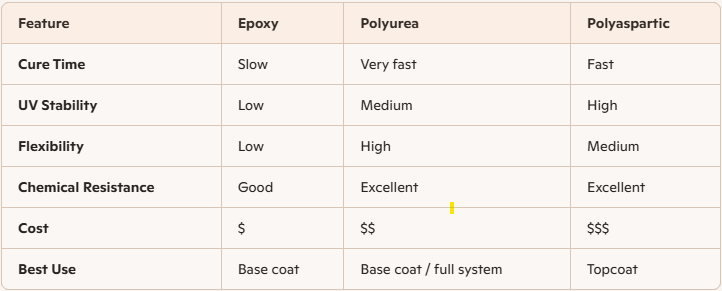
Here’s how the three materials stack up across the metrics that actually matter for a residential garage in Bergen County. Use this table to evaluate what your contractor is proposing — and flag any system that doesn’t account for the UV and flexibility columns.
| Feature | Epoxy | Polyurea | Polyaspartic |
|---|---|---|---|
| Cure Time | 24–72 hours | 30–90 minutes | 1–4 hours |
| UV Stability | Low — yellows without topcoat | Low–Medium — aromatic versions yellow | High — aliphatic, no yellowing |
| Flexibility / Elongation | ~2–5% | 200–400% | 30–60% |
| Compressive Strength | 10,000–12,000 PSI | 6,000–9,000 PSI | 7,000–10,000 PSI |
| Abrasion Resistance (Taber) | ~20–40 mg loss | ~15–30 mg loss | ~10–20 mg loss |
| Chemical Resistance | Good | Excellent | Excellent |
| Cold Weather Application | Above 50°F minimum | Down to -20°F | Down to 0°F |
| Adhesion to Concrete | Excellent | Good | Moderate |
| Typical Cost per Gallon | $ (lowest) | $$ (mid) | $$$ (premium) |
| Best Role in System | Base coat | Base coat / full system | Topcoat |
| Lifespan (residential) | 5–8 yrs standalone | 10–15 yrs full system | 10–15 yrs as topcoat |
What Bergen County Garages Actually Need
Bergen County’s climate is not abstract when it comes to floor coatings — it’s a set of specific mechanical stresses that a coating system either handles or fails under. Getting this right means specifying a system for the actual conditions, not for a showroom in Arizona.
Freeze-thaw cycles run from November through March. Water infiltrates micro-cracks in unsealed concrete, freezes, expands, and widens those cracks incrementally every winter. A rigid coating applied over a slab experiencing this cycle without adequate flexibility will telegraph those cracks through to the surface within three to five years. This is why elongation matters — it’s not a laboratory abstraction, it’s what keeps your floor from cracking at every expansion joint by year four.
Road salt is the silent killer of Bergen County concrete. Chloride ion penetration degrades unreinforced concrete from the inside; on a sealed floor, the threat is edge infiltration — salt-laden water wicking under the coating at the perimeter. A properly installed system with sealed perimeter edges and a floor drain transition is the primary defense. Any contractor who doesn’t address perimeter sealing is leaving the most vulnerable part of the system unprotected.
Older housing stock is the other defining variable. A substantial portion of Bergen County’s residential garages were poured between the 1950s and 1980s — slabs that have moved, settled, and developed hairline cracks over forty or fifty years of freeze-thaw stress. The Ridgewood center-hall colonials with attached two-car garages, the Teaneck split-levels with detached slabs, the Mahwah new construction with three-car garages — each represents a different slab condition and a different flexibility demand. For a 1960s slab in a Teaneck split-level that has clearly moved, a polyurea base coat is not an upgrade; it’s the minimum specification. For a 2018 Mahwah pour, epoxy is a perfectly sound base.
UV exposure varies by door orientation and usage pattern. Garages with large doors that open frequently, or with south- or west-facing openings, receive significant direct UV. In Paramus commercial properties with oversized bay doors, the UV load on the floor surface is substantial for much of the year. A polyaspartic topcoat is non-negotiable in these situations — there is no cost-effective alternative that holds gloss and color under that exposure profile.
The verdict for Bergen County: Based on the specific combination of older slabs, heavy road salt exposure from December through February, sustained freeze-thaw stress, and summer UV intensity, the hybrid system of epoxy base coat plus polyaspartic topcoat is the right answer for most homeowners. For premium installs or slabs with visible movement and existing cracks, upgrade the base coat from epoxy to polyurea. The topcoat stays polyaspartic either way — that part of the equation doesn’t change regardless of what’s underneath it.
The Hybrid System Most Pros Actually Recommend
Professional installers who aren’t on commission for any single product tend to land in the same place. There are three practical tiers, differentiated by slab condition, budget, and performance expectations.
Tier 1 — Standard Hybrid (Most Popular)
Epoxy base coat + polyaspartic topcoat + full flake broadcast
- Best for: Most residential Bergen County garages — newer slabs in good condition, homeowners who want a durable, attractive floor without paying for performance they don’t need
- Cost: Mid-range — the most cost-efficient system that doesn’t compromise on UV stability or long-term durability
- Cure: One-day installation; next-morning return to vehicle traffic
- Lifespan: 10–15 years under normal residential use
Tier 2 — Premium Hybrid
Polyurea base coat + polyaspartic topcoat + full flake broadcast
- Best for: Older slabs with visible movement or hairline cracks, high-end new construction, homeowners who want maximum flexibility and the longest possible system lifespan without re-coating
- Cost: Premium — justified for long-term owners who are making a fifteen-to-twenty year investment
- Cure: Same-day return to service; no overnight wait
- Lifespan: 15–20 years in residential use
Tier 3 — Budget / Indoor Only
Full epoxy system (base coat + color coat, no polyaspartic topcoat)
- Best for: Windowless interior spaces with no UV exposure — utility rooms, basement storage areas, indoor shop floors where appearance is secondary
- Cost: Lowest
- Limitation: Will visibly yellow near windows or any opening that admits natural light; not recommended for standard garages with doors that open to the outside
Whichever tier you choose, the decorative layer sits between the base coat and topcoat — see our full breakdown of epoxy color and finish options to pick the right flake blend and sheen level before you get a quote. Color choice affects the base coat spec more than most homeowners realize, and getting it wrong before the installer arrives means a change order.
How to Choose — Four Questions to Ask Yourself
Strip out the contractor jargon, and the decision comes down to four practical questions. Answer these before your next estimate, and you’ll walk into the conversation knowing what you actually need.
- How much natural light does your garage get? If any sunlight reaches the floor surface — through the main door, side windows, or a sunlit breezeway — you need an aliphatic polyaspartic topcoat. Full stop. There is no workaround that holds gloss and color under sustained UV without it.
- How old is your concrete slab? Slabs poured before 1990 have likely moved and settled through decades of freeze-thaw stress. A polyurea base coat handles that movement far better than rigid epoxy; if your slab has visible cracks or you’ve watched it shift seasonally, plan for Tier 2 from the outset.
- How soon do you need the floor back? Polyaspartic topcoats cure in 1–4 hours; a hybrid system is walkable the same evening and vehicle-ready the following morning. If you genuinely cannot be out of your garage for 48–72 hours, a full-epoxy system isn’t viable — the scheduling problem makes Tier 1 the practical minimum.
- What’s your budget ceiling? Tier 1 — the Standard Hybrid — is the sweet spot for cost versus long-term performance. It outperforms a full-epoxy system on every metric that matters in a Bergen County climate while costing significantly less than the Premium Hybrid. Tier 2 is worth every dollar if you’re a long-term owner who doesn’t want to be back in the estimate cycle in eight years.
Get a Quote From a Bergen County Epoxy Installer
If you’re ready to upgrade your garage floor, read our epoxy flooring cost guide and explore our Bergen County epoxy flooring services and connect with a trusted local installer. You can also browse our full list of service towns to find epoxy flooring professionals near you.