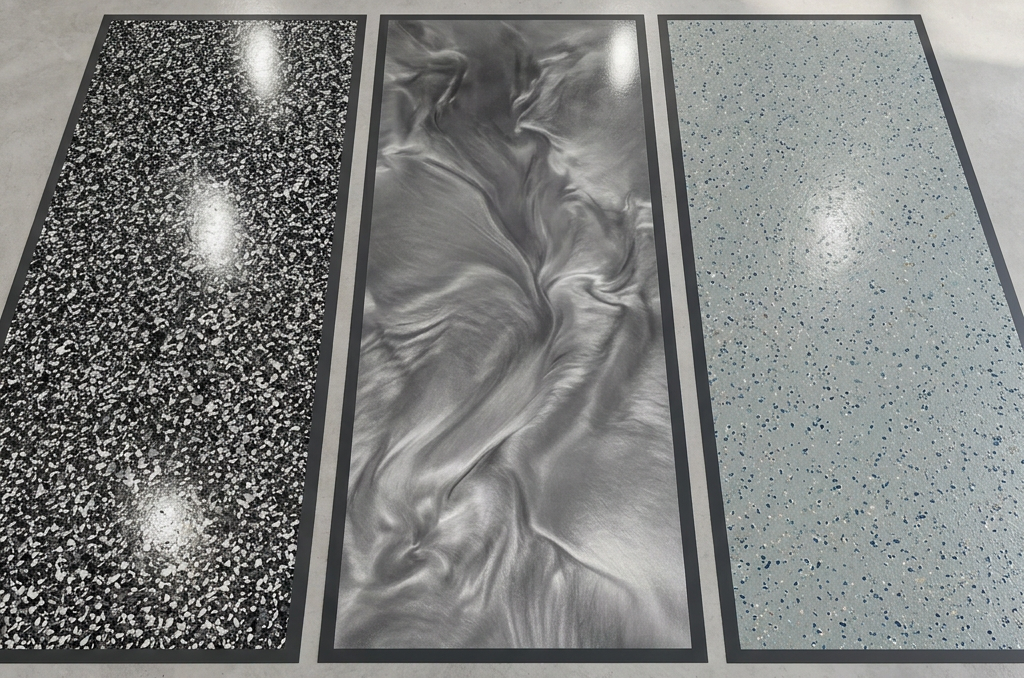
Not long ago, epoxy flooring meant a single shade of battleship gray slapped over a warehouse slab. That era is over. Today, epoxy is one of the most design-forward flooring categories available to homeowners and business owners — a system capable of producing everything from mirror-like showroom gloss to richly textured, multi-tone flake blends that rival high-end tile in visual impact. Color, texture, and finish have become just as important as the durability epoxy has always been known for.
This guide covers everything you need to make a confident, informed decision: the four primary epoxy color systems, how decorative flake blends are constructed and selected, the difference between gloss, satin, and matte topcoats, UV stability, durability data, and specific recommendations for garages, basements, and commercial spaces. Whether you’re researching epoxy garage floor installation for your Ridgewood three-car or exploring residential epoxy flooring services for a finished basement in Mahwah, this is your definitive starting point.
Understanding Epoxy Color Systems
Epoxy flooring is not a single product — it is a layered system, and the color system you choose determines the aesthetic range, surface texture, and performance characteristics of the finished floor. There are four primary color systems used in professional residential and commercial installations.
Solid Color Epoxy
Solid color epoxy is a single-pigment opaque coating applied directly to the prepared concrete slab. It is the most economical epoxy option and produces a clean, uniform appearance. Popular colors include light gray, tan, beige, charcoal, and slate. The look is crisp and industrial — ideal for utility rooms, warehouses, and commercial service spaces where aesthetics take a back seat to function.
The primary limitation of solid color systems is unforgiving honesty: because the coating is opaque and uniform, every crack, patch, divot, and trowel mark in the underlying slab reads through the surface. Concrete that has not been meticulously prepared and repaired will telegraph its flaws clearly. For older slabs common across Bergen County, solid color is rarely the best choice without significant surface remediation.
Flake & Chip Broadcast Systems
Flake and chip broadcast systems are the most popular decorative epoxy option for residential garages and basements, and for good reason. Vinyl or mica flakes are broadcast into a wet epoxy base coat, then sealed with a clear polyaspartic or polyurethane topcoat. The result is a multi-tone, textured surface that:
- Hides surface imperfections in the slab far more effectively than solid color
- Adds subtle slip resistance through the texture of the flake layer
- Offers virtually unlimited color customization through blend mixing
- Photographs exceptionally well for real estate listings
Flake sizes range from 1/16″ (fine, subtle) to 1/4″ (medium, the most common) to 1″ (statement, high visual impact). Broadcast density — the percentage of the base coat surface covered by flakes — is equally important and is discussed in depth in the next section.
Metallic Epoxy Systems
Metallic epoxy systems use metallic or pearlescent pigments suspended in a clear epoxy base, manipulated during application to create swirling, marbled, three-dimensional effects. No two metallic floors are identical — each is essentially a one-of-a-kind installation. This makes metallic systems the highest-end aesthetic option and the most sought-after finish for retail showrooms, finished basements with living area intent, and luxury garages. Because the metallic effect is technique-dependent, these systems require skilled, experienced installers. The margin for error is minimal.
Quartz-Filled Systems
Quartz-filled epoxy systems broadcast colored quartz sand — rather than vinyl flakes — into an epoxy base coat. Quartz systems produce the most slip-resistant and chemically durable epoxy surface available, making them the standard specification for commercial kitchens, hospital corridors, pharmaceutical manufacturing floors, and laboratories where wet conditions, heavy cleaning chemicals, and regulatory compliance are non-negotiable requirements.
Epoxy Flake Blends — Colors, Sizes, and Broadcast Density
Of all epoxy options, flake broadcast systems offer the widest customization range. Understanding how blends are named, constructed, and specified will allow you to choose with precision rather than guesswork.
Flake blends are typically sold under proprietary names that evoke their color palette — names like Domino, Coastal, Desert Sand, Midnight, and Storm are common across the industry. These names correspond to specific combinations of chip colors and proportions that, when broadcast together, produce a cohesive visual effect.
The most widely installed flake blend across New Jersey — and arguably the most versatile in the country — is the Domino blend: a combination of black, white, and gray chips. Its popularity stems from pure practicality:
- Neutral enough to complement virtually any garage door color, cabinetry finish, or home exterior
- Hides oil drips, rubber tire marks, road salt residue, and brake dust with exceptional effectiveness
- Photographs well in natural, LED, and fluorescent lighting alike
- Has broad resale appeal — neither polarizing nor forgettable
The Coastal blend — combining blue, white, and beige chips — has become the preferred choice for finished basements and recreational spaces. Its lighter, cooler palette creates a bright, open feeling that suits gym floors, playrooms, and multi-purpose living areas.
Earth tone blends (tan, brown, cream, and warm gray chips) are a natural fit for colonial and craftsman-style homes that feature brick exteriors, wood trim, and warm interior palettes. These blends extend the home’s design language into the garage or basement without forcing a contrast.
Bold and custom blends — red and black, navy and silver, or fully custom corporate color combinations — serve branded commercial environments and car-enthusiast garages where personality and visual statement are the point. Professional installers can mix custom blends to order from standard chip stock.
Broadcast density is the variable that most homeowners overlook until they see two installations side by side. At 30–50% broadcast density, flakes are scattered across the surface like a speckled terrazzo — the base coat color shows through and contributes significantly to the overall look. At full broadcast (100% coverage), flakes are applied until the base coat is completely hidden, producing maximum texture, maximum grip, and a visually dense surface where the blend color is the entire story.
Flake size also shapes the character of the finished floor in meaningful ways. Finer flakes (1/16″ to 1/8″) produce a refined, uniform texture reminiscent of granite countertop aggregate — subtle and sophisticated. Larger flakes (1/2″ to 1″) create a high-contrast, dramatic visual with more distinct individual chips visible from standing height — better suited to statement spaces than understated ones.
Epoxy Finish Types — Gloss, Satin, and Matte
A critical distinction that surprises many homeowners: the sheen level of your finished floor is determined entirely by the topcoat, not the epoxy base coat or flake blend. The base establishes color; the topcoat establishes sheen, UV resistance, and chemical durability. You can apply a high-gloss topcoat over a muted earth tone blend, or a matte topcoat over a bold metallic — the combinations are independent variables.
High-Gloss Finish
The high-gloss finish remains the most popular choice for garages, showrooms, and commercial spaces. Its mirror-like reflectivity amplifies available light — a significant functional benefit in darker garage interiors — and produces the “showroom-ready” aesthetic that has become the standard expectation for premium residential garage floors. High-gloss surfaces are among the easiest to clean: a mop or squeegee removes most contaminants in a single pass. The trade-off is visibility of dust, footprints, and surface marks between cleanings.
- Best for: Garages, showrooms, retail lobbies, commercial corridors
- Light amplification: Excellent — up to 30% brighter apparent illumination in low-light spaces
- Maintenance: Easy to clean; shows dust more readily between cleanings
Satin Finish
A satin finish delivers 30–50% less reflectivity than a full gloss topcoat. It strikes the most balanced position between aesthetics and everyday practicality: it looks polished and intentional without demanding the diligent maintenance that gloss requires. Satin hides light surface wear and hairline scratches more effectively than gloss, making it a strong choice for high-traffic living areas.
- Best for: Home gyms, utility rooms, mixed-use basements, light commercial
- Maintenance: Forgiving — minor wear and dust are less visible
- Aesthetic: Refined without being dramatic
Matte Finish
The matte finish is the most contemporary of the three options — flat, non-reflective, and architecturally understated. It reduces glare in spaces with abundant natural light and complements modern, minimalist interior design schemes exceptionally well. Matte finishes require a polyurethane topcoat with flatting agents to suppress sheen, making them slightly more complex to achieve than gloss or satin. Minor surface dust and casual marks are less visible on matte surfaces than on gloss.
- Best for: Contemporary homes, sun-lit spaces, offices, clinics
- Consideration: Slightly higher topcoat cost; must be specified explicitly
- Aesthetic: Modern, calm, architectural
One point worth emphasizing: sheen level does not meaningfully affect long-term durability when quality topcoats are used. A professionally installed matte polyurethane topcoat resists abrasion, chemical attack, and hot tire pickup just as effectively as a gloss polyaspartic topcoat of equivalent specification. Sheen is purely an aesthetic decision.
How Homeowners Choose the Right Color
Choosing an epoxy color system involves more than picking a shade you like from a catalog. The decisions that hold up over time are grounded in how the space is actually used, how it is lit, and how it fits into the broader context of the home.
- Start with purpose: A working garage floor prioritizes stain concealment, brightness, and durability above aesthetics. A basement gym needs slip resistance and visual energy. A home office or clinic needs professionalism and visual calm. Let the use case lead.
- Match existing elements: Garage door color, cabinetry finish, wall paint, exposed ceiling joists, and even vehicle color are all legitimate reference points. Some homeowners specifically coordinate their floor with their primary car — a practice more common than installers often let on.
- Think about resale value: Neutral blends — grays, charcoals, and the Domino blend in particular — photograph well for real estate listings and have broad buyer appeal. Bold or niche colors can be polarizing in a sales context, regardless of how well they suit the current owner.
- Respect the lighting: A sample board placed on the actual slab in your actual lighting conditions is the single most reliable decision tool available. Photos on a screen, catalog swatches, and showroom samples all introduce variables that your floor will not replicate.
- The tire test: Dark flake blends — particularly Domino and charcoal-dominant blends — hide oil drips, rubber transfer from tires, and brake dust far more effectively than light or solid-color systems. If your garage sees daily vehicle traffic, this practical factor should weigh heavily.
For Bergen County homeowners in 2026, the four most-requested finishes across Ridgewood, Paramus, Mahwah, and Hackensack are: Domino full-broadcast (the perennial leader), Pewter metallic (silver-gray with dimensional depth), Coastal flake (blue-white for finished basements), and charcoal solid (for clean commercial-adjacent aesthetics in high-end utility spaces).
Durability Differences Between Epoxy Systems
Not all epoxy systems are built equally, and the performance gap between entry-level and professional-grade installations is significant. Understanding the core durability variables allows you to ask the right questions and evaluate proposals with confidence.
- 100% solids epoxy base coat: Produces a 10–15 mil film build, excellent compressive strength, and a rigid surface bond to the concrete substrate. Without a UV-stable topcoat, 100% solids epoxy will chalk and yellow within 12–18 months of UV exposure. Taber abrasion loss (CS-17 wheel, 1,000 cycles) typically runs 20–40 mg — respectable, but not a finished surface specification.
- Polyaspartic topcoat: The current gold standard for garage and commercial epoxy applications. Aliphatic polyaspartic topcoats are UV-stable, cure in under two hours, and produce Taber abrasion loss figures of 10–20 mg. Expected system lifespan in a residential garage: 10–15 years. The one-day installation turnaround — floor back to service in 24 hours — makes polyaspartic the practical choice for homeowners who cannot stage a multi-day project.
- Pure polyurea: The highest-performing material by impact resistance and abrasion metrics. Aromatic polyurea (used as base coats) yellows under UV; aliphatic polyurea topcoats are UV-stable and carry expected lifespans of 15–20+ years. Premium cost positions pure polyurea systems primarily in commercial and industrial applications.
- Flake broadcast as a durability layer: The flake layer itself functions as a sacrificial wear surface, absorbing the initial abrasion load that would otherwise act directly on the clear topcoat. Full-broadcast systems consistently outperform partial-broadcast in topcoat longevity for this reason.
- Quartz systems: The most durable option for wet or chemically aggressive environments. Quartz aggregate interlocks mechanically with the cured epoxy, producing a surface that resists compressive loads, cleaning chemicals, and slip hazards simultaneously.
The most important practical takeaway: the topcoat specification matters more than the base coat color system for long-term durability outcomes. A premium flake blend on a budget topcoat will underperform a basic solid color on a quality aliphatic polyaspartic. Do not economize on the topcoat.
UV Stability — What You Need to Know
UV stability is among the most consequential — and most frequently overlooked — specification decisions in an epoxy installation. Standard bisphenol-A epoxy, the base coat chemistry used in the vast majority of residential and commercial installations, is inherently aromatic in molecular structure. Aromatic compounds are UV-reactive: under prolonged sunlight exposure, they undergo a photo-oxidation process that produces visible yellowing and surface chalking. A light gray or beige epoxy floor installed without a UV-stable topcoat can develop a visible amber or yellow cast within 12–18 months in sun-exposed areas — an outcome that cannot be reversed without recoating.
The solution is straightforward: specify an aliphatic polyaspartic or aliphatic polyurethane topcoat. Aliphatic topcoats contain UV-stable molecular structures that resist photo-oxidation indefinitely under normal exposure. They maintain color, clarity, and gloss across the lifespan of the system.
UV exposure is relevant in more residential contexts than many homeowners anticipate:
- Garages with large doors that are open for extended periods daily
- Basements with egress windows or window wells on south-facing walls
- Sunrooms, covered patios, and three-season spaces
- Retail spaces with large storefront glazing
Bergen County’s NJ summers deliver intense UV index readings, particularly from June through August. Any floor installation near natural light exposure should have an aliphatic topcoat specified in writing on the proposal — ask your installer explicitly. Interior spaces with no natural light whatsoever — windowless storage rooms, mechanical rooms, interior commercial kitchens — are genuinely less susceptible, and aromatic systems perform adequately in those environments.
Garage vs. Basement vs. Commercial — Application Recommendations
Garage Floors
Garage floors carry a demanding and varied load: daily vehicle traffic, hot tire contact from warmed brake rotors, oil drips, road salt tracked in from NJ winters, cleaning chemical exposure, and the expectation of bright, attractive appearance for decades.
- Recommended system: 100% solids epoxy base coat + full-broadcast Domino or charcoal flake + aliphatic polyaspartic high-gloss topcoat
- Why polyaspartic for garages: One-day installation turnaround; UV-stable against open-door sun exposure; hot-tire resistant when cured; back to vehicle traffic in 24 hours
- Optional upgrade: Add aluminum oxide aggregate to the topcoat layer for enhanced slip resistance — particularly valuable if the garage is accessed in wet or snowy conditions
- Surface prep requirement: Mechanical diamond grinding (not acid etching) produces the surface profile necessary for proper adhesion on garage slabs
Basement Floors
Basements present a different set of priorities: aesthetics and livability rise in importance, while moisture management becomes the dominant technical challenge. Concrete slabs below grade are subject to vapor drive — water migrating upward through the slab — which is the leading cause of epoxy delamination failures in basement installations.
- Recommended system: Moisture-vapor barrier primer + 100% solids epoxy base + flake or metallic finish + polyurethane satin topcoat
- Popular finishes: Coastal flake for gym and playroom aesthetics; metallic pewter or blue-gray for finished living area intent
- Critical specification: Calcium chloride vapor transmission testing per ASTM F1869 before any coating is applied. Acceptable threshold is typically under 3 lbs/1,000 sq ft/24 hours for standard epoxy systems. Exceeding this requires a dedicated moisture-mitigation primer — not optional
- Moisture is the number-one failure cause in basement epoxy installations — do not skip the test
Commercial Floors
Commercial epoxy installations are specified with a different lens: the floor must perform consistently under sustained heavy traffic, maintain appearance under commercial lighting scrutiny every business day, meet regulatory or safety requirements, and in many cases reinforce brand identity.
- Recommended system: High-build epoxy base (15–20 mil) + quartz or full-broadcast flake + polyaspartic or polyurethane topcoat
- Retail and showrooms: High-gloss metallic or solid color for premium brand alignment; reflective surfaces increase perceived brightness and space
- Restaurants and commercial kitchens: Quartz broadcast + slip-resistant aggregate; must meet NSF and local health code surface requirements
- Offices and clinics: Solid color satin or matte; anti-static topcoat options available for server rooms and medical environments
- Maintenance planning: Commercial systems with heavy traffic may benefit from topcoat refresh at 7–10 year intervals, which is substantially less disruptive and less costly than full system replacement
Bergen County Epoxy — Local Considerations
Bergen County’s housing stock creates an unusually wide range of flooring contexts within a relatively compact geography. Center-hall colonials in Ridgewood, bi-levels and split-levels in Teaneck and Fair Lawn, expansive newer construction in Mahwah and Upper Saddle River, and dense commercial corridors along Route 17 in Paramus each present distinct requirements that a one-size specification cannot address.
Older slabs — particularly those poured in the 1950s through 1980s, common throughout the county’s established residential neighborhoods — frequently require additional surface preparation beyond standard grinding. Existing paint or sealant layers, carbonation of the surface, and decades of embedded contamination all require mechanical removal before any epoxy system will bond correctly and perform as specified.
NJ winters impose a specific demand on garage floor systems: road salt and deicing chemicals tracked in from driveways are corrosive to both the epoxy film and the underlying slab edges. Sealed perimeter edges and salt-resistant topcoat specifications are important details for Bergen County garages that see year-round vehicle use. Bergen County homeowners also consistently trend toward upscale finishes relative to national averages — metallic systems and designer flake blends significantly outperform plain solid gray as a category share here. The Paramus commercial corridor, in particular, demands floors that read as premium under retail lighting conditions every single day — high-gloss and semi-gloss systems dominate this market as a result.
Get a Quote From a Bergen County Epoxy Installer
If you’re ready to upgrade your garage floor, read our epoxy flooring cost guide and explore our Bergen County epoxy flooring services and connect with a trusted local installer. You can also browse our full list of service towns to find epoxy flooring professionals near you.