If you’re considering a garage epoxy flooring in Bergen County, you’ve probably noticed that the prices vary wildly — from $1,500 to well over $5,000 for a standard two-car garage. That range isn’t random. It reflects real differences in coating systems, prep quality, concrete condition, and the experience level of the contractor behind the quote.
This guide breaks down exactly what you’re paying for, what separates a coating that lasts 20 years from one that peels in three, and what Bergen County homeowners should expect to pay in 2026 — with real-world price scenarios you can use as a benchmark before an installer walks through your garage door.
Bergen County Epoxy Flooring Price Ranges at a Glance
Bergen County sits in North Jersey’s premium labor market. Expect to pay 15–25% above national averages, consistent with the broader Northeast region. Here is how pricing breaks down by system type for a professionally installed garage floor coating:
Standard Solid-Color Epoxy: $3–$5 per sq ft
A basic single-color system. Adequate for low-traffic garages, but susceptible to UV yellowing and hot-tire pickup over time. Best suited for short-term use or pre-sale cosmetic upgrades.
Full Flake Epoxy System: $5–$8 per sq ft
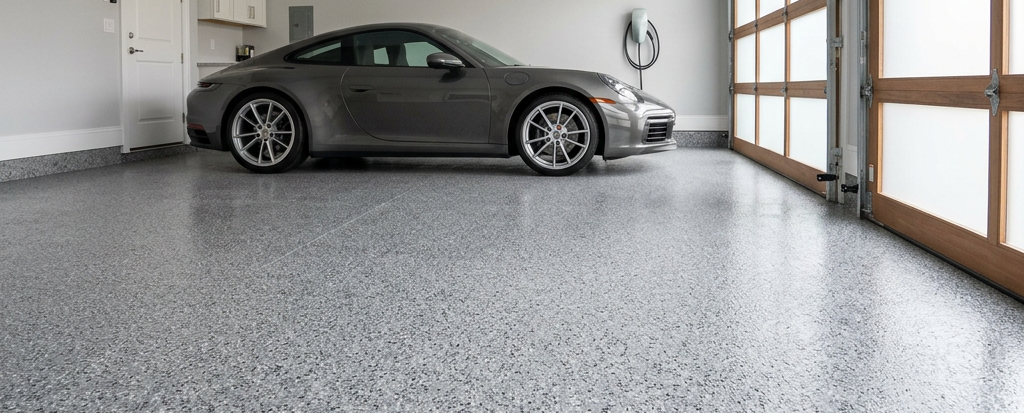
The most popular residential choice in Bergen County. Decorative vinyl flakes broadcast over an epoxy base deliver a slip-resistant texture, hide daily dirt and oil drips, and extend the visual life of the floor. Typical lifespan of 10–15 years with proper prep.
Polyaspartic / Polyurea Hybrid: $7–$12 per sq ft
The premium residential standard. An epoxy base coat is topped with a polyaspartic or polyurea finish that is UV-stable, hot-tire resistant, and cures fast enough for one-day installations. Lifespan of 15–20+ years. The go-to system for homeowners who want to do it once and be done.
Metallic Epoxy: $8–$15 per sq ft
A show-floor finish with swirling metallic pigments. Less common in working garages — more often used in luxury garage builds, showrooms, or finished basement floors where appearance is the primary goal.
Bergen County Average Installed Cost by Garage Size:
- 1-car garage (~240 sq ft): $1,200 – $2,880
- 2-car garage (~400 sq ft): $2,000 – $4,800
- 3-car garage (~600 sq ft): $3,000 – $7,200
Note: These ranges assume a garage in reasonable condition with standard prep. Slabs with significant damage, moisture issues, or existing coatings will push costs toward the higher end of each range.
What Drives the Cost of Garage Epoxy Flooring?
Understanding the cost factors behind a quote is the best way to protect yourself from an underbid that will fail in two years. Here is what actually moves the needle on price.
Garage Size and Layout
Square footage is the starting point, but it is not the only dimension that matters. Columns, floor drains, coved base edges running up the wall, and built-in cabinets all add edgework and taping time. Cove base installation — running the coating 4–6 inches up the wall for a clean, seamless finish — typically adds $3–$6 per linear foot. Odd-shaped garages, tight doorways, and limited ventilation access can also increase labor hours.
Concrete Condition and Prep Work
This is the single biggest variable in any epoxy flooring quote. Surface preparation accounts for 40–60% of total labor on a properly installed job. Concrete that is cracked, spalled, oil-saturated, or covered by a previous coating requires more grinding, patching, and degreasing before any coating can be applied. Skimping here is the primary reason garage floor coatings peel — and why the cheapest quote is frequently the most expensive long-term decision.
Concrete condition surcharges to expect:
- Hairline crack filling: $1–$3 per linear foot
- Larger crack or spall repair: $75–$300 per area
- Old coating removal (grinding): $1–$2 per sq ft add-on
- Oil degreasing and contamination removal: $0.50–$1.50 per sq ft add-on
Coating System Type
Material costs escalate as you move from water-based epoxy to 100%-solids epoxy to polyaspartic and polyurea systems. Professional-grade polyaspartic topcoats cost significantly more per gallon than standard epoxy, and they require faster, more skilled application — which adds to labor rates. A contractor who has never applied polyaspartic is not the right person to install it in your Bergen County garage.
Add-Ons and Extras
Flake color blends, anti-slip aggregates, additional topcoats, striping, wall protection, and UV-resistant clear coats all add to the base price. These are not gimmicks — a polyaspartic topcoat, for example, is what makes the difference between a floor that yellows in a sunny garage and one that holds its finish for 20 years. Ask your contractor what is included in the system, not just the price.
Surface Prep — The Most Important Line in Your Quote
No part of a garage epoxy installation matters more than what happens before the coating is mixed. A floor coated over improperly prepared concrete will fail regardless of how premium the product is. When vetting contractors, ask these two questions directly: How do you prep the surface? Do you grind?
Diamond Grinding vs. Acid Etching
Diamond grinding — using a walk-behind floor grinder fitted with diamond segment tooling — mechanically profiles the concrete surface, creating the microscopic peaks and valleys the coating bonds into. This is the industry standard for durable residential coatings.
Acid etching uses a chemical solution (typically muriatic acid) to open the surface pores. It is faster and cheaper, but industry professionals widely consider it inadequate for coatings that need to last. The profile is inconsistent, it does not remove oil contamination, and it leaves a residue that interferes with adhesion. A quote that does not include diamond grinding is a red flag, regardless of how good the price looks.
Crack and Spall Repair
All visible cracks should be evaluated before coating, not ignored or painted over. Structural movement cracks may indicate a foundation issue that needs addressing before any floor coating is applied. Non-structural hairline cracks can be filled with polyurea or polyurethane joint filler. Large spalls — pitting or flaking of the concrete surface — should be patched with a cementitious repair compound and allowed to cure before grinding. These steps add cost, but omitting them guarantees a compromised finish.
Oil Stain Removal
Bergen County garages that have housed vehicles for years are commonly oil-saturated in drip zones. Epoxy does not bond over oil. Contaminated areas require a dedicated degreaser application, mechanical scrubbing, and in severe cases, additional grinding passes or the application of a specialty adhesion primer. Always point out oil stains when a contractor is quoting — how they address this issue tells you a great deal about the quality of their process.
Moisture Testing — The Step Most Contractors Skip
Concrete slabs breathe. Moisture vapor migrates up through the slab from the soil below, and when it becomes trapped under an impermeable epoxy coating, it creates hydrostatic pressure that delaminates the coating from the concrete. This is called moisture vapor emission, and it is one of the leading causes of epoxy floor failure — including in garages that looked fine at the time of installation.
The Two Standard Tests
Calcium Chloride Test (ASTM F1869): A dish of dry calcium chloride is sealed under a dome on the concrete surface and left for 60–72 hours. The amount of moisture absorbed reveals the Moisture Vapor Emission Rate (MVER) in pounds per 1,000 sq ft per 24 hours. Most standard epoxy systems require an MVER below 3 lbs; polyaspartic systems may tolerate slightly higher rates. Cost: $100–$300 flat.
In-Slab Relative Humidity Test (ASTM F2170): A more precise method. Sensors are inserted into holes drilled into the slab at a specified depth and left for at least 24 hours to equilibrate. Most epoxy manufacturers specify a maximum RH of 75–80% for their standard systems. Some moisture-mitigating primers extend tolerance up to 95–100% RH.
What Happens If You Skip It
Moisture testing is an additional cost that some contractors skip to win a lower bid. If your slab has elevated moisture and the contractor does not test, the coating will eventually fail — often within the first year — and the contractor’s warranty (if they offer one) will exclude moisture-related delamination. Request proof of moisture testing before installation begins. If your slab fails the test, a moisture-mitigating epoxy primer system adds approximately $300–$2,000 to the project cost depending on the severity — but it is far less expensive than a full re-installation.
Epoxy vs. Polyurea vs. Polyaspartic — Which Is Right for Your Bergen County Garage?
These three terms are often used interchangeably in marketing, but they represent meaningfully different products with different performance profiles. Here is how they compare across the factors that matter most for a Bergen County garage:
Feature Epoxy Polyurea / Polyaspartic Hybrid System Cost per sq ft $3–$8 $7–$13 $7–$12 UV Stability Poor (yellows) Excellent Excellent Cure Time 12–72 hours 2–24 hours 2–24 hours Hot-Tire Resistance Moderate Excellent Excellent Road Salt Resistance Good (with topcoat) Excellent Excellent Lifespan 5–15 years 15–20+ years 15–20+ years DIY Friendly Yes (limited) No No Best For Budget upgrades, pre-sale Premium one-time install Most Bergen County homeowners The Hybrid System: The Bergen County Sweet Spot
The most common premium installation in North Jersey is a hybrid system: a 100%-solids or water-based epoxy base coat, a decorative vinyl flake broadcast, and a polyaspartic or polyurea topcoat. This approach gives you the bonding strength and economics of epoxy on the base, with the UV stability, fast cure, and chemical resistance of polyaspartic on top. It is why most professional contractors in Bergen County recommend this system for residential garages — it balances cost, durability, and appearance more effectively than either product alone.
Real-World Price Scenarios for Bergen County Homeowners
The following examples are based on 2026 contractor pricing in the Bergen County market. They assume professionally installed systems with proper diamond grinding, moisture testing, and manufacturer-compliant application.
Scenario 1 — 1-Car Garage, Basic Flake Epoxy
240 sq ft, minimal concrete damage, no moisture issues, standard gray flake, single topcoat.
Estimated total: $1,440 – $1,920
Scenario 2 — 2-Car Garage, Full Flake System with Cove Base
400 sq ft, moderate oil staining requiring degreasing, full flake broadcast, cove base up perimeter walls (~80 linear feet), standard polyurethane topcoat.
Estimated total: $2,400 – $3,600
Scenario 3 — 2-Car Garage, Premium Polyaspartic Hybrid
400 sq ft, one hairline crack repair, moisture test (passing), 100%-solids epoxy base, multi-color flake blend, polyaspartic topcoat, anti-slip additive.
Estimated total: $3,200 – $4,800
Scenario 4 — 3-Car Garage, Polyaspartic with Moisture Mitigation
600 sq ft, slab fails calcium chloride test requiring moisture-barrier primer, full flake broadcast, polyaspartic topcoat.
Estimated total: $5,100 – $7,500
These scenarios illustrate why two quotes on the same garage can differ by $2,000 or more — if one contractor includes moisture testing, crack repair, and a proper prep process, and the other does not, you are not comparing equivalent systems.
The Bergen County Climate Factor
Homeowners in Paramus, Ridgewood, Mahwah, and every other Bergen County town that sees a full Northeast winter know the damage road salt and freeze-thaw cycles inflict on concrete. Salt that gets tracked in on tires seeps into exposed concrete pores, expanding as it crystallizes and breaking down the surface from within. An unprotected or poorly coated concrete floor deteriorates measurably faster than a properly sealed one.
For Bergen County garages, the right system must include:
- Mechanical surface prep — diamond grinding opens the pores for a chemical bond that salt cannot dislodge
- A polyaspartic or polyurea topcoat — these are significantly more chemical- and salt-resistant than standard epoxy alone
- Anti-slip aggregate — wet floors from snow melt are a safety hazard; a textured topcoat addresses this without sacrificing appearance
- VOC-compliant products — New Jersey DEP VOC regulations limit which coatings can be legally used in residential settings; confirm your contractor uses compliant materials
Get a Quote From a Bergen County Epoxy Installer
If you’re ready to upgrade your garage floor, explore our Bergen County epoxy flooring services and connect with a trusted local installer. You can also browse our full list of service towns to find epoxy flooring professionals near you.